in 2025
in the Wild
Exploit
Exploitable Vulns
Your security team is patching as fast as they can. They're working down the list - CVSS 9.8s first, then the 9.0s, then the 8.5s. It feels logical.
Here's the problem: most of those "critical" vulnerabilities will never be exploited. And while your team burns through them, the ones attackers are actually using sit in the queue.
In 2025, 48,185 new CVEs were published - a 20% increase from 2024's 39,962.
Security teams can realistically remediate a fraction of their vulnerability backlog. The rest sits in the queue, aging.
Meanwhile, the window for exploitation keeps shrinking.
In 2021, the average time-to-exploit was 32 days. By 2025, it's down to 5 days.
Attackers are faster, more automated, and they're not waiting for you to work through your CVSS-sorted list.
What's Actually Happening
Your current approach relies on CVSS scores - a technical severity rating that measures how bad a vulnerability could be in a perfect attack scenario. A CVSS 9.8 means this is theoretically very dangerous.
But CVSS doesn't tell you:
- Is this vulnerability on a system that matters to your business?
- Are attackers actually exploiting it in the wild?
- Is it even exposed in a way that's exploitable in your environment?
The result: Your team treats every high-CVSS finding as urgent, regardless of actual risk.
The Real Cost
Security analysts spend roughly 60% of their time remediating vulnerabilities that pose minimal actual risk.
For a three-person team on $130K each fully loaded, that's roughly $235K a year chasing vulnerabilities that will never be exploited - while the CVSS 7.5 on your customer-facing payment server, the one attackers are actively exploiting, sits in the queue for weeks.
When those missed vulnerabilities get hit, the average breach costs $4.88 million (IBM, 2024). Not because you didn't scan. Because you fixed the wrong things first.
A Recent Example
In December 2021, Log4Shell (CVE-2021-44228) hit with a CVSS score of 10.0 - maximum severity. Every organization started emergency patching. But a CVSS 10.0 meant very different things depending on where it lived:
The pattern: CVSS tells you the severity. It doesnt tell you which systems you cant afford to lose.
What Risk-Based Prioritization Actually Means
Risk-based vulnerability prioritization (also known as Risk-based vulnerability management) isn't a new tool. It's a methodology that adds context to vulnerability data you already have.
Instead of asking 'how severe is this vulnerability?' you ask 'what's the actual risk to my business if this gets exploited?'
That question breaks down into three factors.
Factor 1: Business Context
Not all systems are equal. A critical vulnerability on your test environment is annoying. The same vulnerability on your payment processing system could shut down revenue.
Factor 2: Exploitability
A vulnerability's technical severity (CVSS) tells you what's possible. Exploitability tells you what's probable.
CISA Known Exploited Vulnerabilities (KEV): This is a catalog maintained by the U.S. Cybersecurity and Infrastructure Security Agency of vulnerabilities confirmed to be exploited in the wild. If a CVE is on the KEV list, attackers are actively using it. Treat every KEV entry as urgent.
Exploit Prediction Scoring System (EPSS): EPSS uses machine learning to predict the probability that a vulnerability will be exploited in the next 30 days. Scores range from 0% to 100%.
CVSS asks "how bad could this be?". EPSS asks "how likely?".
Combining both provides the foundation for risk-based prioritization.
Factor 3: Environmental Context
A high-severity vulnerability on a critical asset can still be lower risk if attackers can't reach it to exploit it.
It is determined by these factors:
Financial Impact of Risk-Based Prioritization
Your current CVSS-only approach has two major cost drivers: wasted effort on vulnerabilities that don't matter, and missed threats on systems that do.
Here are real implementation results from a mid-sized financial services company.
What Implementation Actually Looks Like
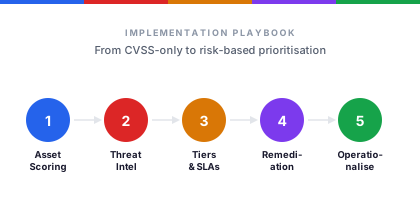
RBVM isn't a software purchase. It's a process change using data you already have.
Timeline: 30-90 days depending on organization size.
- Identify crown jewels
- Score: revenue, dependency, data sensitivity, business continuity
- Integrate CISA KEV
- Utilize EPSS v4 scores
- Connect with CMDB
- Classify assets into risk tiers: Critical / High / Medium / Low
- Set SLAs: 24hr / 7d / 30d / 90d
- Remediate Critical/High
- Measure MTTR against new SLAs
- Automate assignment by risk tier
- Establish risk-based reporting
- Train team on new prioritization workflow
- Define risk acceptance and exception process
Getting Organizational Buy-In
RBVM requires alignment across multiple stakeholders.
Why Boards Are Starting to Care
Three regulatory developments are pushing vulnerability management up the board agenda.
- SEC cybersecurity disclosure rules require documented risk management processes - CVSS-only triage is hard to defend as mature methodology.
- EU DORA (January 2025) requires vulnerability handling proportionate to business risk, not just technical severity.
- NIS2 expands this across essential and important EU entities, with fines up to €10M or 2% of global turnover.
Quick Assessment
Final Thoughts
Your team already knows the backlog is unwinnable. They've known for years. What they're waiting for is a clear mandate: to stop treating every vulnerability equally, and to focus on what actually threatens the business.
That's a leadership decision, not a technical one.